
Breathing Exercises to Fall Asleep Faster After 50
This article contains affiliate links. As an Amazon Associate, we earn from qualifying purchases, at no extra cost to you. Learn more.
It is 2 a.m., and you are watching the clock while your mind replays the day. You count the hours left, and that math only makes you more awake. Slow, steady breathing can help your body settle, though it is a helpful habit and not a cure.
Many women in and past menopause find that sleep gets lighter and more broken. You will find practical methods here, plus the honest limits of the research. You will also learn when breathlessness needs a doctor.
The guide also shows where cognitive behavioral therapy for insomnia (CBT-I) fits. CBT-I is a structured, short-term talk therapy that changes the thoughts and habits that keep you awake, usually delivered over several sessions with a trained provider. You do not need special equipment, only a few quiet minutes and a little patience.
Key Takeaways
- Slow breathing calms the body, but it is not a cure for insomnia.
- Night sweats and worry often explain why sleep changes after 50.
- A long, slow exhale matters more than perfect counts.
- Breathlessness when you lie down needs a doctor, not more breathing practice.
- The military sleep trick’s two-minute claim has not been proven.
- Trouble sleeping 3 nights a week for 3 months deserves a doctor visit.
- CBT-I has the strongest backing for long-term insomnia.
Why Falling Asleep Can Feel Harder After 50
Trouble sleeping after 50 is common, and menopause is one of the main reasons. Hormone shifts around menopause commonly bring night sweats and lighter, more broken sleep. Your trouble is far from rare. See menopause and sleep for more.
A pilot study of 43 perimenopausal or postmenopausal women had a mean age of 53.6 years. All had insomnia and at least one nighttime hot flash per night. Menopause insomnia like theirs is a real, studied problem.
Hot flashes at night can wake you and make bedtime feel stressful. Stress and pain add to it. Worry about sleep itself often keeps the mind alert at bedtime.
That worry becomes its own trigger, which is why calming the body helps. A hot flash waking you at 3 a.m. is a different problem from taking an hour to fall asleep. The fixes differ.
Jot down for a week whether your trouble is falling asleep or staying asleep, because that tells you which tools to reach for first.
What Breathing Can and Cannot Do for Sleep
Slow breathing reliably calms the body, but calming the body and falling asleep faster are not the same result. A calmer body is not proof of faster sleep. Slow breathing slows your heart rate and eases the body toward its rest-and-digest response, so bedtime can feel calmer.
Take the research on 4-7-8 breathing. A 2022 study of healthy adults aged 19-25 looked at its immediate effects on heart rate, blood pressure and heart-rate variability. It did not measure how long people took to fall asleep.
What it did find is that heart rate and systolic blood pressure decreased significantly in both the sleep-deprived and control groups. That fits the idea of a calmer body. It says little about sleep speed.
Studies so far are small and often use young, healthy volunteers. Results for women over 50 may differ. The evidence for sleep specifically is still thin.
Breathing works best as a daily habit and as one tool among several. Treat any breathing routine as a two-week experiment and note how you feel at bedtime, not just how fast you drift off.
How to Use Breathing Exercises to Fall Asleep in Bed
4-7-8 breathing is a counted pattern of inhale, hold and long exhale that you can do lying down with your eyes closed. It means breathing in for a count of four, holding for seven, and breathing out for eight, repeated for four cycles. No method promises sleep in minutes, so judge it over weeks.

4-7-8 Breathing Step by Step
Lie on your back and follow these steps.
- Relax your lips and empty your lungs through your mouth.
- Breathe in through your nose for a count of 4.
- Hold your breath for a count of 7.
- Breathe out slowly through your mouth for a count of 8.
- Repeat for four cycles.
The counts matter less than a long, slow exhale. If holding for seven feels uncomfortable, shorten the counts to 3-5-6.
Slow-Paced Breathing for 15 Minutes
Slow-paced breathing means unhurried breathing at about six breaths a minute or slower. In a 30-day study, people practiced it for 15 minutes each evening. Compared with social-media use, it improved their sleep quality in healthy young adults.
That group was young, so treat the result as a hint. Try about 15 minutes in the evening, with a soft exhale and no strain.
Belly Breathing When Your Mind Is Racing
Put one hand on your belly. Let it rise as you breathe in and fall as you breathe out. Watching that hand gives a busy mind something simple to follow.
Stop and breathe normally if you feel dizzy. Ask your doctor first if you have a lung or heart condition.
Practice once or twice during the day first, so the counts feel automatic when you are tired at bedtime.
The Military Sleep Method and Other Quick Tricks
The army sleep trick is a head-to-toe relaxation routine, and its famous two-minute promise comes from a 1981 book. The claim that 96% of pilots fell asleep within two minutes after six weeks of practice is not from a peer-reviewed study. No modern clinical trial has tested the method as a complete package.
The routine itself is simple. You relax your face, drop your shoulders, and breathe out slowly. Then you relax your legs and clear your mind for about ten seconds.
Do not confuse it with Navy SEAL style box breathing. Box breathing uses equal counts in, hold, out and hold. People use it for stress, not as a sleep method.
The relaxation steps are harmless and may help you wind down. They work as practice, not as a one-night fix, and nothing here lets you fall asleep fast on demand. Other sleep tricks follow the same rule.
If you try it, give it two weeks of nightly practice before you decide whether it suits you. For more bedtime techniques, see how to fall asleep faster after 50.
Short of Breath When You Lie Down: What to Do
If lying down makes you short of breath, do not try to breathe your way through it, because that pattern needs a doctor’s attention. Shortness of breath that happens while lying down and improves when you sit or stand is called orthopnea. It is usually a sign of an underlying medical condition.
Talk to your doctor about it. This guide cannot diagnose you, and breathing exercises are not a fix for breathlessness.
| What you notice | What it may point to | What to do |
|---|---|---|
| Breathlessness that eases when you sit up | Orthopnea | See your doctor |
| Sudden severe breathlessness, chest pain or pressure, bluish lips or fingertips, or gasping while speaking | Emergency | Call 911 or go to an emergency room |
| Slow breathing that only feels odd during practice | Normal adjustment | Return to normal breathing and shorten the counts |
Healthy adults aged 18-65 generally breathe 12 to 20 times a minute while awake. Breathing changes during sleep, so one night’s count is not a diagnosis. Deep breathing while sleeping is natural, and you cannot control it, so the practice happens before sleep.
Sitting up or propping yourself with pillows can ease discomfort while you arrange a medical visit. Keep a note of how many pillows you need and how often it happens, since your doctor will ask.
Breathing for Night Wakings, Anxiety and Hot Flashes
Waking at 3 a.m. with a pounding heart is a good moment for slow breathing, not a deadline. Let your exhale run longer than your inhale. A 2025 experiment with 27 people found that slow breathing reduced reported anxiety compared with fast breathing.
That matters because worry is a common reason sleep stalls. The experiment compared fast and slow breathing during certain and uncertain threat. It was small, so use it as a gentle nudge.
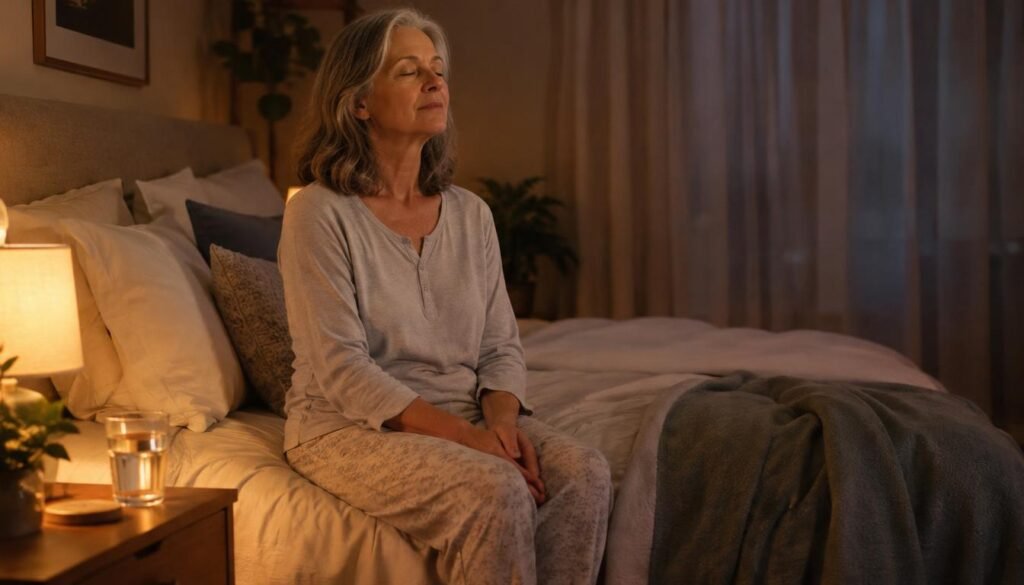
Try this routine when you wake:
- Keep the lights low.
- Make each exhale longer than the inhale.
- Drop your shoulders.
- Count ten slow breaths.
- Stay in bed relaxed, and do not check the clock.
For a hot flash, slow breathing may take the edge off the stress, but it will not stop the flash. Avoid forcing deep breaths hard enough to feel lightheaded.
If you are still wide awake after what feels like 20 minutes, get up, sit in dim light, and return to bed when you feel drowsy. For more on night waking, see why you wake up at 3 a.m.
How CBT for Insomnia Works Alongside Breathing
CBT-I is the treatment with the strongest backing for long-term insomnia, and breathing can be one of its tools. The American Academy of Sleep Medicine (AASM) gives CBT-I a strong recommendation for chronic insomnia disorder in adults. Treatment typically involves 4 to 8 sessions.
What CBT-I Involves
Sessions cover changing sleep habits, adjusting your time in bed, and working with worried thoughts. They also teach relaxation skills, which can include breathing. A 2015 meta-analysis of 20 randomized trials found CBT-I cut sleep latency, the time it takes to fall asleep, by an average of 19 minutes. It also improved sleep efficiency by 10%.
CBT-I Adapted for Menopause
A review of randomized trials found CBT-I improved sleep quality and reduced insomnia severity in menopausal women. Improvements were reported to last up to six months. One menopause-adapted version used four individual 50-minute sessions over eight weeks.
In a pilot study, it brought short-term gains in insomnia severity, hot-flash interference, sleep self-efficacy and depressive symptoms. The benefits declined over three months of follow-up. That makes booster practice matter.
| What it targets | Typical time commitment | Strength of evidence | |
|---|---|---|---|
| Breathing exercises | Bedtime tension | Minutes a night | Small studies, mostly healthy volunteers |
| CBT-I | Habits and thoughts that keep insomnia going | 4-8 sessions | AASM strong recommendation |
Breathing is a good first step. CBT-I is the stronger step if insomnia keeps returning.
Ask your doctor for a referral to a trained CBT-I provider, and ask whether digital or telehealth options are covered by your plan. Our guide to CBT for insomnia explains what to expect.
When to Talk With Your Doctor About Insomnia
If you have had trouble sleeping 3 or more nights a week for 3 months or longer, it is time to see your doctor. That pattern is called persistent insomnia. Insomnia counts as chronic when trouble falling asleep, staying asleep or waking too early lasts at least three months and causes significant daytime impairment.
Go sooner if poor sleep affects your daytime mood, focus or safety. Drowsy driving is a good reason not to wait.
Bring these to your visit:
- A one-to-two-week sleep log
- A list of current medicines and supplements
- How often hot flashes or night sweats happen
- The breathing methods you have tried
Your doctor can check for other causes of poor sleep, such as sleep apnea, mood changes and medicine effects. You can also talk through treatment choices. Do not start or stop any medicine without your doctor’s guidance.
Book the visit even if breathing exercises help a little, since feeling better is not the same as treating the cause.
Want to try 4-7-8 breathing with a guide?
Physical therapist Dr. Jo walks you through the 4-7-8 breathing technique for falling asleep.
What helps set up a calmer space for bedtime breathing?
Breathing practice is easier in a cool, dark, quiet room. These well-reviewed tools help with that:
- MZOO Contoured Sleep Mask: Blocks light without pressing on your eyelids, so you can close your eyes and focus on your breath without early light pulling you awake. More than 100,000 reviews. Check Price on Amazon
- Magicteam White Noise Machine: Steady, non-looping sound with an all-night setting. Many people find it easier to pace slow breaths against a soft, constant background. Check Price on Amazon
- ThermoPro TP50 Indoor Thermometer: Shows your bedroom's real temperature and humidity, so you can keep the room cool enough to cut down on hot flash wake-ups. Check Price on Amazon
- The Women's Guide to Overcoming Insomnia by Shelby Harris, PsyD: A sleep psychologist's self-help guide built on CBT-I methods, with chapters on perimenopause and menopause, including relaxation and breathing skills. Check Price on Amazon
Conclusion
Better sleep after 50 is usually built from small habits, and breathing is an easy one to start. Slow breathing is a gentle, low-risk habit that can ease bedtime tension. Persistent insomnia deserves a doctor, and CBT-I deserves a look.
Tonight, pick one breathing method, give it ten calm minutes, and write down how you felt in the morning.
Try this next: If it is your mind, not your body, that keeps you up, pair your breathing practice with the tools in how to stop racing thoughts at night, such as a worry list before bed and getting up when you cannot settle.
Frequently asked questions
Is 8 breaths per minute while sleeping bad?
One low reading is not a diagnosis. Healthy adults aged 18-65 generally breathe 12-20 times a minute while awake, and breathing changes during sleep. A single count can also be off if you were disturbed while measuring. Ask your doctor if you notice repeated pauses, gasping or daytime sleepiness.
What is the best trick to fall asleep quickly?
No single trick works for everyone. A steady wind-down routine, a slow, long exhale and a cool, dark room help more than racing the clock. Watching the time often adds stress, so turn the clock away. Give any new habit a couple of weeks before judging it.
What will knock me out to sleep?
Nothing safe works instantly. Steady habits and slow breathing help you drift off over time, and a regular bedtime supports both. Any sleep medicine should be discussed with your doctor, never improvised, because the right choice depends on your health and your other medicines.
What is the army sleep trick?
It is a head-to-toe relaxation routine with slow breathing. You relax your face, shoulders and legs, then clear your mind briefly. Its famous two-minute success rate comes from a 1981 book and has not been tested in a modern trial. The steps are harmless, so try them for a few weeks.
How often should I practice breathing exercises for sleep?
Practice daily, for 5-15 minutes in the evening. Add a short practice or two in the daytime until the pattern feels automatic. Daily repetition teaches your body the cue, so a steady routine beats long sessions once in a while. Keep a short note of how you feel at bedtime.
Is 4-7-8 breathing safe if I have a lung or heart condition?
Ask your doctor first. Holding your breath can feel uncomfortable with these conditions. You can shorten the counts, for example to 3-5-6, and keep the exhale long. Stop and breathe normally if you feel dizzy or short of breath, and do not push through it.
Do I need CBT-I if breathing exercises help?
Breathing may be enough for occasional trouble. If insomnia happens 3 nights a week for 3 months, ask about CBT-I, which typically takes 4-8 sessions. It targets the habits and thoughts that keep insomnia going, which breathing alone does not change. Your doctor can refer you to a trained provider.
Sources and further reading
- Sleep and Older Adults, National Institute on Aging
- Sleep Problems and Menopause: What Can I Do?, National Institute on Aging
- Management of Chronic Insomnia Disorder in Adults, American College of Physicians, 2016
- Relaxation techniques: Try these steps to lower stress, Mayo Clinic
- Insomnia: Diagnosis and treatment, Mayo Clinic
- Diaphragmatic breathing, Wikipedia
- Relaxation technique, Wikipedia
A quick note: this is general health information, not medical advice. Talk with your doctor about sleep problems, and before starting, stopping, or changing any medicine or supplement.